2027 International Conference on Resource Sustainability (icRS 2027)

June 28-30, 2027, Aalborg, Denmark

The sustainable development of human society depends on resources. Addressing critical societal challenges, such as climate change, resource depletion, and environmental protection, requires sustainable management of resources using interdisciplinary approaches.

The International Conference on Resource Sustainability (icRS) series serve as an international platform for researchers and practitioners around the world with diverse background and expertise to share the most recent ideas, outcomes, and practices on resource sustainability.

icRS embraces interdisciplinarity, welcoming contributions from ANY discipline including natural sciences, social sciences, and engineering on ANY aspect of resource sustainability. We define resource broadly, including physical resources, biological resources, and "misplaced" resources:

  • physical resources: metals, non-metallic minerals, energy, water, etc.
  • biological resources: food, forestry, land, ecological systems, etc.
  • "misplaced" resources: air emissions, water pollutants, solid waste, etc.

To encourage participation, we will ONLY call for abstracts to submit for the conference. However, authors will have options to select to submit full papers in addition to abstracts to be considered for special issues in supporting journals.

We also welcome proposals to organize special sessions at icRS 2027.

icRS 2027 is in-person only. There will be no option for online presentations.

icRS 2027 is sponsored by the flagship journal in sustainable resources management Resources, Conservation & Recycling (RCR; 2025 Impact Factor: 10.4) and its sister journal Resources, Conservation & Recycling Advances (RCRADV; 2025 Impact Factor: 8.3). High quality papers presented at icRS 2027 will be recommended to special issues in these journals as well as other supporting journals.

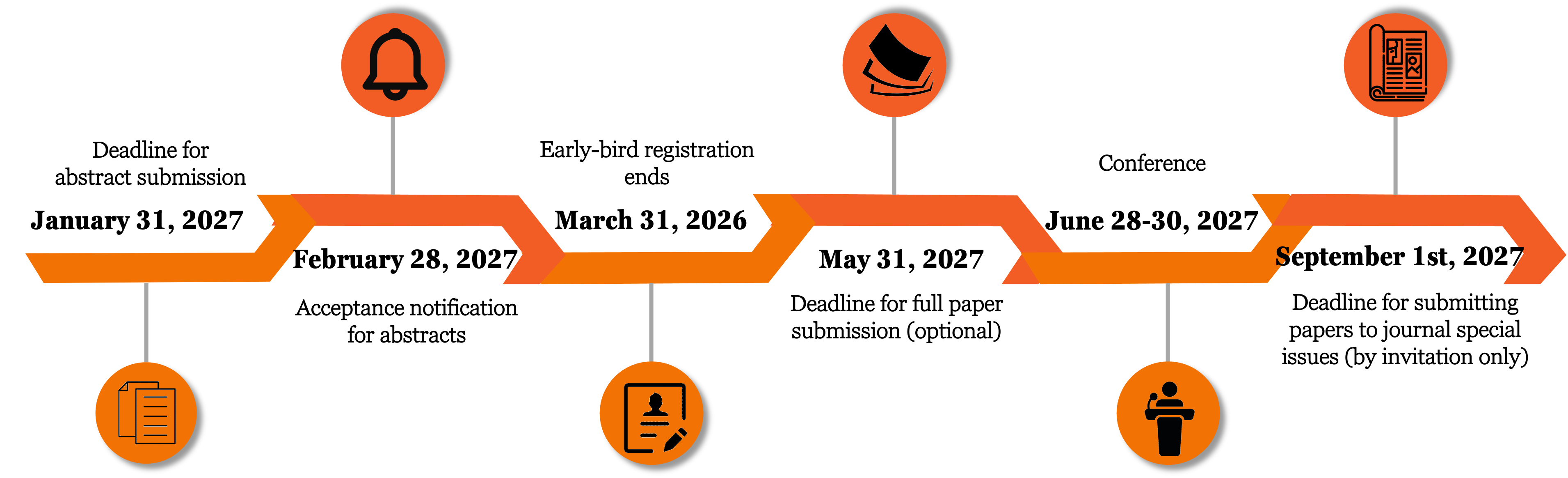
Important Dates

  • January 31, 2027: Deadline for abstract submission
  • February 28, 2027: Acceptance notification for abstracts
  • March 31, 2027: Early-bird registration ends (at least one author should register before Early Bird ends; otherwise an accepted abstract will be removed from the conference program and not be considered for journal special issues; an author can only register for no more than two accepted presentations)
  • May 31, 2027: Deadline for full paper submission through the conference system (optional)
  • June 28-30, 2027: Conference
  • September 1st, 2027: Various: Deadlines for submitting papers to journal special issues (dates vary across journals and will be notified via email).
Committees

icRS 2027 is pleased to have its Advisory Committee composed by the Editorial Boards of RCR and RCRADV and its Scientific Board composed by the Editors of RCR and RCRADV.

Advisory Committee (RCR and RCRADV Editorial Board)

  • Julian Allwood, University of Cambridge
  • Annick Anctil, Michigan State University
  • Sergio Angulo, University of Sao Paulo
  • Chunguang Bai, University of Electronic Science and Technology of China
  • David Broadstock, National University of Singapore
  • Jorge de Brito, University of Lisbon Higher Technical Institute
  • Ichiro Daigo, University of Tokyo
  • Jo Dewulf, Ghent University
  • Liang Dong, City University of Hong Kong
  • Matthew Eckelman, Northeastern University
  • Jose-Luis Galvez-Martos, IMDEA Energy
  • Nishant Garg, University of Illinois Urbana-Champaign
  • Alexandre Bacelar Gonçalves, University of Lisbon
  • Thomas Graedel, Yale University
  • Willi Haas, University of Natural Resources and Life Sciences Vienna
  • Seiji Hashimoto, Ritsumeikan University
  • Gang He, Baruch College, City University of New York
  • Monzur Imteaz, Swinburne University of Technology
  • Md Tasbirul Islam, King Fahd University of Petroleum and Minerals
  • Kannan Govindan, University of Southern Denmark
  • Alissa Kendall, University of California, Davis
  • Yasushi Kondo, Waseda University
  • Simonov Kusi-Sarpong, University of Southampton
  • Gang Liu, Peking University
  • Yanchen Liu, Tsinghua University
  • Rui Cunha Marques, University of Lisbon
  • Daniel Beat Müller, Norwegian University of Science and Technology
  • Kok Siew Ng, University of Oxford
  • Chi-Sun Poon, Hong Kong Polytechnic University
  • Helmut Rechberger, Vienna University of Technology
  • Vasco Sanchez Rodrigues,Cardiff University
  • Heinz Schandl, CSIRO
  • Lei Shen, Chinese Academy of Sciences
  • Rafat Siddique, Thapar Institute of Engineering & Technology
  • Avishreshth Singh, India Institute of Technology Tirupati
  • Matthew Stasiewicz, University of Illinois Urbana-Champaign
  • Guido Sonnemann, University of Bordeaux
  • Meng Sun, Tsinghua University
  • Valerie Thomas, Georgia Institute of Technology
  • Jinping Tian, Tsinghua University
  • Timothy Townsend, University of Florida
  • Ian Vázquez-Rowe, Pontifical Catholic University of Peru
  • Ming-hung Wong, The Education University of Hong Kong
  • Ernst Worrell, Utrecht University
  • Beidou Xi, Chinese Research Academy of Environmental Sciences
  • Zhifeng Yang, Guangdong University of Technology
  • William Young, University of Leeds
  • Lixiao Zhang, Beijing Normal University
  • Tieyong Zuo, Beijing University of Technology

Scientific Committee (RCR and RCRADV Editors)

  • Gisele Azimi, University of Toronto
  • Fazleena Badurdeen, University of Kentucky
  • Krishna Prapoorna Biligiri, Indian Institute of Technology Tirupati
  • Zhi Cao, Nankai University
  • Wei-Qiang Chen, Chinese Academy of Sciences
  • Steven De Meester, Ghent University
  • Xiangzheng Deng, Chinese Academy of Sciences
  • Elham Fini, Arizona State University
  • Luca Fraccascia, Sapienza University of Rome
  • Magnus Fröhling, Technical University of Munich
  • Pezhman Ghadimi, University College Dublin
  • Oliver Heidrich, Newcastle University
  • Andrea Hicks, University of Wisconsin-Madison
  • Melanie Jaeger-Erben, Brandenburg University of Technology
  • Mitchell Jones, Vienna University of Technology
  • Ramzy Kahhat, Pontifical Catholic University of Peru
  • Vikas Khanna, University of Pittsburgh
  • Junbeum Kim, University of Applied Sciences Troyes
  • Shihong Lin, Vanderbilt University
  • Ruth Mugge, Delft University of Technology
  • Rupert Myers, Imperial College London
  • Keisuke Nansai, National Institute for Environmental Studies, Japan
  • Lanndon Ocampo, Cebu Technological University
  • Elsa Olivetti, Massachusetts Institute of Technology
  • Sergio Pacca, University of Sao Paulo
  • Shen Qu, Beijing Institute of Technology
  • Veena Sahajwalla, University of New South Wales
  • Joseph Sarkis, Worcester Polytechnic Institute
  • Sabrina Spatari, Israel Institute of Technology
  • Gara Villalba, Autonomous University of Barcelona
  • George Wells, Northeastern University
  • Yufeng Wu, Beijing University of Technology
  • Yuan Yao, Yale University
  • Steven Young, University of Waterloo

Conference Chair

  • Yang Cheng, Aalborg University

icRS General Chair

  • Ming Xu, Tsinghua University

Organization Committee

  • Lirong Liu, University of Surrey
  • Chenyang Shuai, Chongqing University
  • Tiantian Feng, China University of Geosciences
  • Bu Zhao, University at Albany, SUNY

Call for Submissions

icRS 2027 welcomes submissions of abstracts, full papers, and special session proposals on topics related to sustainable management of resources from any discipline.

Abstract

All authors who wish to present at the conference should submit an abstract. Abstracts should be submitted in plain text with no more than 300 words. The abstract should be written in clear and concise English and the presentation is oral only. At least one author of an accepted abstract should register in order to keep the presentation in the program.

Full papers (optional)

Only accepted abstracts can submit full papers. Full papers are optional, but are required if to be considered for one of the special issues sponsoring icRS 2027. Full paper template can be downloaded here.

Special session proposal

icRS 2027 welcomes proposals to organize special sessions which focus on topics that are highly relevant and timely to the conference. Special session organizers should solicit interested authors to prepare abstracts on related topics and, if the special session proposal is approved, coordinate submission of the abstracts. A special session is confirmed when the proposal is approved and at least four presentations are accepted and registered.

Special session proposal should include the proposed session title (no more than 80 characters with space), short acronym (no more than 20 characters), rationale of the special session (no more than 300 words), organizer(s) information (name, title, affiliation, email), and information on at least four expected presentations (title, author name, author affiliation).

Submission

To be updated

Registration Information

To be updated

Conference Program

To be updated

Confirmed Plenary Speakers

To be updated

Venue

To be updated


Travel, Accommodation and Visa

To be updated